
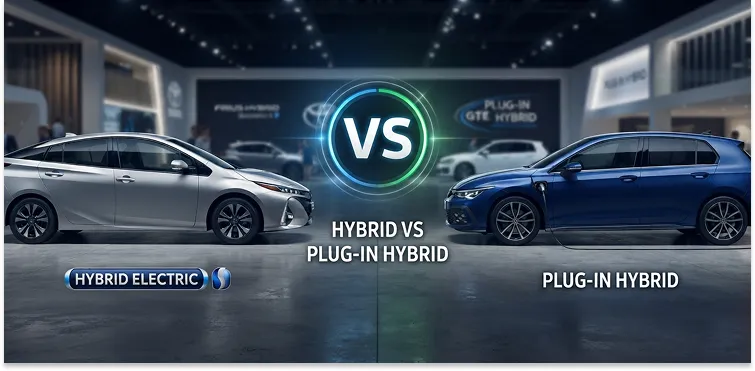
Choosing between a hybrid and a plug-in hybrid can be difficult. Both combine a petrol or diesel engine with an electric motor to improve fuel efficiency and reduce emissions, but they differ in how they use and recharge electric power.
A conventional hybrid charges its battery while driving, mainly through regenerative braking and the engine. A plug-in hybrid (PHEV) has a larger battery that can be charged externally, allowing it to travel much farther using electric power alone.
The better choice depends on your daily driving distance, access to charging, budget, and long-distance driving needs. If you’re buying a car from a top dealer, understanding these key differences can help you choose the vehicle that best suits your lifestyle.
Key Differences at a Glance
Both hybrids and plug-in hybrids offer better fuel efficiency, but they work differently. The table below highlights their key differences to help you quickly understand which option may better suit your driving needs.
| Feature | Hybrid Car | Plug-In Hybrid |
| Electric-only driving range | Usually a few miles to around 30 miles, depending on the model | Often around 20–60+ miles, depending on the model |
| Charging | Does not normally require external charging | Requires or benefits from regular charging |
| Fuel economy | Efficient in city and mixed driving | Extremely efficient when regularly charged |
| Purchase price | Usually lower | Usually higher |
| Battery size | Smaller | Larger |
| Vehicle weight | Lighter | Heavier |
| Long-distance convenience | Very convenient | Convenient, but may use more fuel after battery charge is depleted |
| Best for | Drivers wanting simple, fuel-efficient motoring | Drivers who can charge regularly and complete many short journeys electrically |
Learn More:
- AWD vs FWD Explained
- Certified Pre-Owned vs Regular Used Car
- New vs Used Car
- Mercedes vs Porsche
- BMW vs Audi for US Military
- AWD vs 4WD
- Electric Cars vs Hybrid Cars
Electric-Only Driving Range
One of the biggest differences between a hybrid and a plug-in hybrid is how far the vehicle can travel using electric power alone.
This is also an important factor to look for when buying a car, especially if you want to complete your daily journeys with minimal fuel use.
Hybrid Car
A conventional hybrid has a relatively small battery. The electric motor assists the petrol engine and may power the vehicle by itself for short periods, especially at low speeds or during gentle acceleration.
The exact electric-only range depends on the vehicle and driving conditions. In many conventional hybrids, electric driving is mainly used for short distances rather than extended journeys. The petrol engine automatically starts when more power is needed or when the battery charge is low.
This makes a hybrid a practical option for drivers who want the benefits of electric assistance without changing their driving or charging habits.
Plug-In Hybrid
A plug-in hybrid has a much larger battery pack. Because of this, it can normally travel a considerably longer distance on electric power alone.
For many drivers, the electric range of a PHEV is enough for daily commuting, school runs, shopping trips, and local journeys. If the battery is fully charged, some everyday trips can be completed without using the petrol engine at all.
Once the electric charge is depleted, the vehicle operates much like a conventional hybrid, using its combustion engine and electric motor together.
Charging Requirements
Charging is another major difference between these two types of electrified vehicles.
Understanding how each system works can also help you avoid common dealer tricks to watch out for when comparing vehicle features, charging costs, and advertised fuel savings.
Hybrid Car
A standard hybrid does not usually need to be plugged into a wall socket or public charging station. Its battery is charged automatically through regenerative braking and energy produced by the engine.
Regenerative braking captures some of the energy that would normally be lost when the vehicle slows down. This energy is then stored in the battery and used to help power the electric motor.
This is one of the biggest advantages of a conventional hybrid. You can simply refuel the car at a petrol station and continue driving without worrying about charging cables, home charging points, or public charging networks.
Plug-In Hybrid
A plug-in hybrid is designed to be charged from an external power source. You can charge it at home using a suitable charging point or, depending on the vehicle and location, use public charging infrastructure.
Regular charging is important if you want to achieve the best fuel economy from a PHEV. A plug-in hybrid with a full battery can complete many short journeys using mostly electric power. However, if you rarely charge it, you may be carrying a large battery without taking full advantage of its electric driving capability.
For this reason, a plug-in hybrid is generally most suitable for drivers who have convenient access to charging.
Fuel Economy
Both vehicle types can use less fuel than a conventional petrol or diesel car, but their real-world fuel economy depends heavily on how they are driven.
For someone buying a car for the first time, understanding these differences can help make it easier to choose the most fuel-efficient option for their daily driving needs.
Hybrid Car
A conventional hybrid can deliver excellent fuel economy without requiring any special driving routine. It is particularly efficient in urban areas, where frequent braking allows the battery to recover energy.
The electric motor can assist during acceleration, while the petrol engine may switch off when the vehicle is stopped or moving under suitable conditions. This helps reduce fuel consumption in traffic and during low-speed driving.
For drivers who want a simple way to reduce fuel use, a hybrid offers a strong balance between efficiency and convenience.
Plug-In Hybrid
A plug-in hybrid can achieve outstanding fuel economy when it is charged regularly and used for short daily journeys.
For example, a driver may commute to work using electric power, recharge the vehicle at home, and use very little petrol during the week. On longer journeys, the petrol engine provides additional flexibility.
However, fuel economy can be less impressive if the battery is rarely charged. The larger battery makes the vehicle heavier, so a PHEV that is driven with an empty battery may not be as efficient as drivers expect.
Purchase Price
The initial purchase price matters, especially when buying a car on a tight budget.
Conventional hybrids usually cost less than plug-in hybrids, but comparing models and learning to negotiate the best price can help you get better value.
Hybrid Car
Hybrid cars are generally less expensive to buy than comparable plug-in hybrid models. Their smaller battery packs and simpler charging requirements help keep the purchase price lower, making them a practical choice for budget-conscious buyers exploring different ways to finance a car.
This makes a conventional hybrid an attractive option for buyers who want better fuel economy without paying the additional cost of a larger battery and plug-in technology.
Plug-In Hybrid
Plug-in hybrids usually cost more than similar conventional hybrids. The larger battery, additional electrical components, and charging technology can increase the vehicle’s purchase price.
However, the higher upfront cost may be worthwhile for drivers who regularly use electric power. Lower fuel consumption and possible incentives or tax benefits in some regions may also help reduce the long-term cost of ownership.
Before buying, it is important to consider the total cost rather than only the purchase price. Insurance, servicing, energy costs, tax, depreciation, and charging expenses can all affect the overall value of the vehicle.
Daily Driving Distance
Your typical daily mileage is one of the most important factors when choosing between a hybrid and a plug-in hybrid.
If you are buying a used vehicle, it is also wise to test drive a car properly before buying so you can see how it feels during your usual type of driving.
Hybrid Car
A conventional hybrid works well for a wide range of driving patterns. It is especially useful if your daily journeys vary significantly or you do not want to plan around charging.
Whether you drive a few miles around town or complete a longer commute, the vehicle automatically switches between the petrol engine and electric motor as needed.
This makes a hybrid a good choice for people who want efficiency without changing their usual routine.
Plug-In Hybrid
A plug-in hybrid can be an excellent choice if your daily driving distance is within the vehicle’s electric-only range.
For example, if your daily commute is relatively short and you can charge at home overnight, you may be able to complete most journeys using electric power. This can significantly reduce petrol consumption.
However, if your daily driving distance is regularly much longer than the vehicle’s electric range, the petrol engine will be used more often. In that situation, a conventional hybrid may provide a simpler and more cost-effective solution.
Access to Charging Infrastructure
Your access to charging can make a major difference to the practicality of a plug-in hybrid.
Hybrid Car
A conventional hybrid is ideal for drivers who do not have access to a home charging point.
You do not need a dedicated parking space with an electrical connection. The vehicle charges itself while driving, so your main responsibility is simply keeping the fuel tank filled.
This is particularly convenient for people who live in apartments, park on the street, or frequently travel to places where charging facilities are limited.
Plug-In Hybrid
A plug-in hybrid works best when charging is easy and convenient.
Home charging is often the most practical option because you can plug the vehicle in overnight. Workplace charging or reliable public charging can also make PHEV ownership more convenient.
If charging is difficult, inconvenient, or expensive, you may not use the vehicle’s electric capabilities regularly. In that case, the benefits of choosing a plug-in hybrid can be reduced.
Long-Distance Driving Convenience
Both hybrids and plug-in hybrids can be used for long journeys, but they offer slightly different experiences.
Hybrid Car
A conventional hybrid is extremely convenient for road trips. You can refuel at a petrol station in much the same way as you would with a traditional petrol car.
There is no need to plan your journey around charging stops. This can be particularly useful for drivers who regularly travel between cities or take long-distance trips.
Plug-In Hybrid
A plug-in hybrid also provides excellent long-distance flexibility because the petrol engine can take over when the battery charge is depleted.
The advantage is that you can use electric power for shorter journeys and still have the freedom to travel long distances without relying entirely on public charging infrastructure.
However, once the battery is depleted, the vehicle may become heavier and less efficient than it is when operating with a full charge. For drivers who frequently travel long distances, a conventional hybrid may sometimes offer a more straightforward experience.
Battery Size and Vehicle Weight
Battery size affects several aspects of a vehicle, including its weight, available space, performance, and efficiency.
When evaluating a used vehicle, it is also important to consider the signs of a bad car you should avoid, such as unusual battery performance, warning lights, or other signs of poor maintenance.
Hybrid Car
A conventional hybrid uses a smaller battery pack. This helps keep the vehicle relatively light and allows the petrol engine and electric motor to work together efficiently.
The smaller battery also means the car does not need as much space for electrical components. Depending on the model, this may help preserve interior or boot space.
Plug-In Hybrid
A plug-in hybrid requires a larger battery to provide its longer electric-only range. This increases the vehicle’s weight.
The additional weight can affect handling, acceleration, fuel economy, and tyre wear. However, it also gives the PHEV the ability to complete more journeys using electric power.
The ideal choice depends on whether the benefits of longer electric driving outweigh the disadvantages of carrying a larger battery.
Environmental Impact and Emissions
Both hybrid vehicles and plug-in hybrids can help reduce emissions compared with conventional petrol or diesel vehicles, but their environmental benefits depend on how they are used.
Hybrid Car
A conventional hybrid generally uses less fuel than a similar non-hybrid vehicle. Lower fuel consumption normally means lower tailpipe carbon dioxide emissions.
Its ability to recover energy through regenerative braking also improves efficiency, particularly in urban driving conditions.
Because the vehicle does not need to be plugged in, its environmental performance is not dependent on whether the owner regularly charges the battery.
Plug-In Hybrid
A plug-in hybrid can produce very low tailpipe emissions during electric-only driving. When regularly charged and used mainly for short trips, it can significantly reduce petrol consumption.
However, the environmental benefits depend heavily on charging habits. A PHEV that is rarely charged may use its petrol engine most of the time, while still carrying the additional weight of a larger battery.
The best environmental results generally come when owners charge the vehicle regularly and use electric power for as many suitable journeys as possible.
Overall Suitability for Your Driving Lifestyle
The best vehicle is the one that fits your daily routine. Before choosing between a hybrid and a plug-in hybrid, consider your typical driving distance, charging access, budget, and how often you take long journeys.
If you are also buying a used vehicle, using a complete car inspection checklist can help you assess its overall condition before making a decision.
Hybrid Car
A hybrid may be the better choice if:
- You do not have convenient access to charging.
- You want a simple ownership experience.
- Your driving distance varies considerably.
- You frequently take long journeys.
- You want to reduce fuel consumption without changing your routine.
- You prefer a lower purchase price compared with a plug-in hybrid.
A conventional hybrid is often the easiest transition from a traditional petrol or diesel vehicle to electrified driving.
Plug-In Hybrid
A plug-in hybrid may be the better option if:
- You can charge at home or work.
- Most of your daily journeys are relatively short.
- You want to drive on electric power regularly.
- You still need the flexibility of a petrol engine for long journeys.
- You are comfortable charging the vehicle frequently.
- You want to reduce fuel use during everyday driving.
For the right driver, a PHEV can provide a useful combination of electric driving and long-distance flexibility.
Advantages and Disadvantages of Hybrid
A hybrid can be a smart choice for drivers who want better fuel efficiency without the need to charge their vehicle regularly.
However, like any technology, it also has a few limitations. Here are the main advantages and disadvantages to consider.
Advantages of a Hybrid
- No regular external charging is required.
- Generally lower purchase price than a comparable PHEV.
- Good fuel economy, especially in urban driving.
- Easy to use for long-distance travel.
- Smaller battery can mean lower vehicle weight.
- Familiar refuelling experience.
- Suitable for drivers without home charging access.
Disadvantages of a Hybrid
- Limited electric-only driving range.
- Cannot normally complete long daily journeys using electric power alone.
- May offer less electric driving capability than a plug-in hybrid.
- Fuel savings may be lower than those of a regularly charged PHEV for short journeys.
Advantages and Disadvantages of Plug-In Hybrid
Plug-in hybrids offer more electric driving capability and can be highly efficient when charged regularly.
However, their higher cost and charging requirements may not suit every driver. Here are the main advantages and disadvantages to consider.
Advantages of a Plug-In Hybrid
- Longer electric-only driving range.
- Can reduce petrol use significantly when charged regularly.
- Useful for short daily commutes and local journeys.
- Offers the flexibility of a petrol engine for long-distance travel.
- Can provide a practical transition toward fully electric driving.
- May offer lower emissions during electric driving.
Disadvantages of a Plug-In Hybrid
- Usually more expensive to purchase.
- Requires regular charging to achieve its full potential.
- Larger battery adds weight.
- Can be less efficient if driven mostly with a depleted battery.
- Charging infrastructure may not be convenient for every driver.
- The technology can be more complex than that of a conventional hybrid.
Which Vehicle Is More Reliable?
Both hybrid and plug-in hybrid vehicles can be reliable when properly maintained. A conventional hybrid is often simpler because it has a smaller battery and does not need external charging.
Plug-in hybrids have larger batteries and additional charging components, but this does not necessarily make them less reliable. The vehicle’s make, model, maintenance history, and battery condition are more important factors.
When buying a used hybrid or PHEV, always check the service history and have the battery and hybrid system inspected by a qualified technician.
Final Verdict
So, which is better: a hybrid or a plug-in hybrid? A conventional hybrid is ideal if you want better fuel efficiency, simple ownership, and no need to worry about charging, especially if you often take long journeys.
A plug-in hybrid may be the better choice if you can charge regularly and most of your daily driving falls within its electric range. This allows you to reduce fuel use while still having a petrol engine for longer trips.
Ultimately, the right choice depends on your lifestyle. Consider your daily mileage, access to charging, long-distance driving habits, and budget before choosing between a hybrid and plug-in hybrid.