
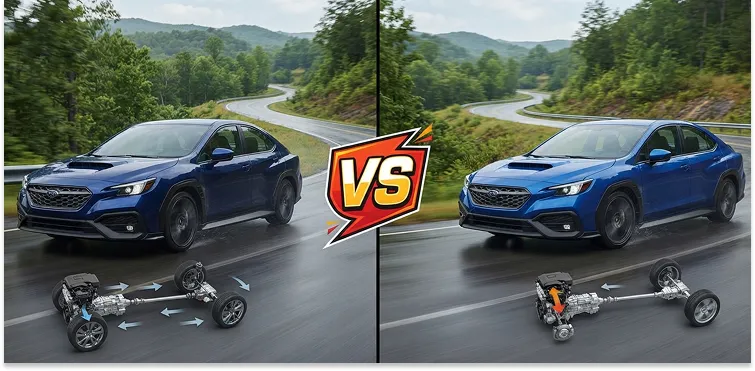
AWD (All-Wheel Drive) and FWD (Front-Wheel Drive) are two of the most common drivetrain systems found in modern vehicles. While both are designed to move your car efficiently, they offer different advantages depending on where and how you drive.
If you’re buying a car, understanding how AWD and FWD differ can help you make a smarter decision. AWD provides extra traction by sending power to all four wheels, making it a great choice for slippery roads and changing weather. FWD, on the other hand, is lighter, more fuel-efficient, and typically costs less to buy and maintain, making it ideal for everyday driving.
In this guide, we’ll explain the differences between AWD and FWD, compare their performance, and help you choose the drivetrain that best fits your driving needs, budget, and lifestyle.
Key Differences Between AWD vs FWD
Compare the key differences between AWD and FWD to see how they perform in traction, efficiency, cost, and everyday driving.
| Feature | AWD (All-Wheel Drive) | FWD (Front-Wheel Drive) |
| Power Distribution | Sends power to all four wheels | Sends power only to the front wheels |
| Traction | Excellent on slippery roads | Good in normal driving conditions |
| Performance | Better acceleration and stability | Efficient for everyday driving |
| Cornering | More grip through turns | Predictable and easy to control |
| Fuel Economy | Lower due to added weight | Better fuel efficiency |
| Rain & Snow | Excellent confidence | Good with quality tires |
| Off-Road Capability | Handles light off-road terrain | Not designed for off-road use |
| Maintenance | Higher maintenance costs | Lower maintenance costs |
| Purchase Price | Usually more expensive | More affordable |
| Best For | Snow, mountains, rough weather, performance | City driving, commuting, long-distance travel |
What Is All-Wheel Drive (AWD)?
All-Wheel Drive (AWD) is a drivetrain that sends power to all four wheels. This helps the vehicle maintain better traction and stability, especially on slippery roads.
Most AWD systems automatically adjust how power is distributed based on road conditions. This gives the vehicle more grip on rain, snow, ice, and gravel.
AWD is a great choice for drivers who often travel in bad weather or on rough roads.
What Is Front-Wheel Drive (FWD)?
Front-Wheel Drive (FWD) is a drivetrain that sends power only to the front wheels. These wheels handle both steering and driving the vehicle.
FWD vehicles are lighter, more fuel-efficient, and usually cost less than AWD models. They are also simpler and cheaper to maintain.
FWD is ideal for everyday driving, including city roads, highways, and daily commuting. It offers a comfortable and reliable driving experience for most drivers.
1. Power Distribution
Power distribution is the biggest difference between AWD and FWD, as it determines how engine power reaches the wheels and directly affects traction, stability, and overall driving performance.
AWD
AWD continuously or automatically distributes power between the front and rear wheels. Some advanced systems even adjust the amount of torque sent to each wheel individually for maximum control.
This intelligent power management helps maintain traction when road conditions suddenly change.
Advantages
- Better grip during acceleration
- Improved stability
- Automatic power adjustment
- Increased driver confidence
FWD
FWD sends all engine power to the front wheels. Since the front wheels already support much of the vehicle’s weight, they usually maintain good traction during normal driving.
Although power is limited to the front axle, modern traction control systems help prevent wheel spin in many situations.
2. Traction and Grip
Traction and grip play a major role in how confidently a vehicle handles slippery and challenging road conditions.
AWD
Traction is one of AWD’s biggest strengths. Because power reaches all four wheels, the vehicle can maintain grip even if one or two wheels begin slipping.
This makes AWD especially useful on:
- Snow
- Ice
- Mud
- Wet pavement
- Gravel roads
Drivers often notice better stability when starting from a stop on slippery roads.
FWD
FWD provides solid traction under normal road conditions. Since the engine sits over the front wheels, additional weight improves grip during acceleration.
For areas with mild winters, FWD paired with quality winter tires performs surprisingly well.
3. Performance and Acceleration
Performance and acceleration affect how quickly a vehicle responds, especially during starts, overtaking, and highway driving.
AWD
Performance-oriented vehicles often use AWD because it transfers engine power more effectively.
Instead of two wheels struggling for grip, four wheels work together to launch the vehicle. This reduces wheel spin and improves acceleration.
Sports cars and high-performance SUVs frequently rely on AWD for quicker starts and better control.
FWD
FWD vehicles generally offer smooth acceleration for daily driving.
While they may not launch as quickly as AWD vehicles, they provide more than enough performance for commuting, family transportation, and highway cruising.
4. Handling and Cornering
Handling and cornering determine how stable and controlled a vehicle feels when navigating turns and curves.
AWD
AWD improves stability while cornering by distributing torque where it’s needed most.
Many advanced AWD systems help reduce understeer and increase confidence when driving on winding roads.
Drivers often feel more planted during fast turns.
FWD
FWD offers predictable handling that is easy for most drivers to control.
When pushed aggressively into a corner, FWD vehicles may experience understeer, where the vehicle tends to continue straight rather than turn sharply.
For everyday driving, this predictable behavior is actually considered a safety advantage.
5. Fuel Efficiency
Fuel efficiency is an important factor, especially if you want to reduce fuel costs and maximize mileage over time.
AWD
Because AWD systems include extra components such as differentials, transfer cases, and additional drive shafts, they add weight to the vehicle.
More weight means:
- Higher fuel consumption
- Increased drivetrain resistance
- Slightly lower efficiency
Although modern AWD systems have become more efficient, they still consume more fuel than comparable FWD models.
FWD
Fuel efficiency is one of the biggest advantages of FWD.
With fewer moving parts and a lighter drivetrain, FWD vehicles require less energy to operate.
Drivers who travel long distances or have daily commutes often save a significant amount on fuel over time.
6. Driving in Rain and Snow
Road conditions can change quickly in rain and snow, making traction and stability more important than ever.
AWD
AWD provides greater confidence on slippery roads.
Whether driving through heavy rain, fresh snow, or icy streets, the system quickly transfers power to the wheels with the most grip.
It’s important to remember that AWD helps you accelerate and maintain traction, but it does not shorten braking distances. Safe driving habits and quality tires remain essential.
FWD
FWD handles rain very well and performs adequately in light snow.
Many drivers in colder regions successfully use FWD vehicles throughout winter by installing dedicated winter tires.
For areas with occasional snow, FWD is often more than sufficient.
7. Off-Road Capability
Off-road capability shows how well a vehicle can handle rough, uneven, and unpaved terrain beyond regular roads.
AWD
Although AWD is not the same as four-wheel drive (4WD), it handles light off-road conditions much better than FWD.
It performs well on:
- Dirt roads
- Gravel trails
- Forest roads
- Light mud
- Uneven terrain
However, serious off-roading typically requires a true 4WD system with low-range gearing.
FWD
FWD is designed primarily for paved roads.
Driving on rough terrain increases the likelihood of losing traction, especially on steep hills or loose surfaces.
For occasional camping trips on maintained dirt roads, FWD can still perform adequately.
8. Maintenance Costs
Maintenance costs can have a big impact on the overall cost of owning a vehicle over time.
AWD
AWD systems contain more mechanical and electronic components.
This means there are additional parts that may require servicing or repairs over the life of the vehicle.
Maintenance may include:
- Differential fluid changes
- Transfer case servicing
- Additional drivetrain inspections
Repair costs are generally higher if major AWD components fail.
FWD
FWD has a simpler design with fewer drivetrain components.
This often results in:
- Lower repair costs
- Less maintenance
- Easier servicing
- Lower long-term ownership expenses
For budget-conscious buyers, this simplicity is a major advantage.
9. Purchase Price
Purchase price is often a deciding factor, especially when comparing vehicles with different drivetrain systems.
AWD
Vehicles equipped with AWD typically cost more because of the added engineering and drivetrain components.
Depending on the manufacturer and model, AWD can increase the purchase price by several thousand dollars.
However, many buyers find the additional confidence worth the investment.
FWD
FWD vehicles are generally more affordable.
Lower manufacturing costs translate into lower purchase prices, making them attractive to first-time buyers, families, and commuters.
Insurance premiums may also be slightly lower in some cases.
10. Best Everyday Driving Experience
Your daily driving habits play a key role in deciding which drivetrain offers the best overall experience.
AWD
For drivers who regularly experience changing weather or travel through mountain regions, AWD delivers outstanding peace of mind.
It offers:
- Excellent stability
- Confident acceleration
- Improved grip
- Smooth driving in poor weather
Many modern AWD systems operate seamlessly without requiring any driver input.
FWD
FWD remains the preferred choice for millions of drivers because it excels in everyday situations.
It offers:
- Comfortable handling
- Better fuel economy
- Lower ownership costs
- Reliable performance
- Easy maneuverability in city traffic
If your driving is mostly on paved roads, FWD provides an excellent balance of value and practicality.
Which Is Better for Different Driving Needs?
The right drivetrain depends on where and how you drive.
Choose AWD if you:
- Live in areas with frequent snow or ice.
- Drive on mountain roads or steep hills.
- Often travel on gravel or unpaved roads.
- Want maximum traction and stability.
- Enjoy spirited driving or need stronger acceleration.
- Frequently tow small trailers or carry heavy loads.
Choose FWD if you:
- Mostly drive in cities or suburbs.
- Commute daily on paved roads.
- Want better fuel economy.
- Prefer lower purchase and maintenance costs.
- Rarely encounter severe weather.
- Need a reliable family or commuter vehicle.
For many households, a FWD vehicle is the most practical and economical choice. However, if your environment regularly presents challenging road conditions, AWD can provide additional confidence and safety.
Final Verdict
AWD vs FWD isn’t about which drivetrain is better overall—it’s about which one best fits your driving needs. Your climate, road conditions, budget, and daily driving habits should guide your decision.
Choose AWD if you regularly drive in rain, snow, or on rough roads and want extra traction and stability. Choose FWD if you mainly drive on paved roads and prefer better fuel economy, lower maintenance costs, and a more affordable vehicle.
Ultimately, the right choice is the one that matches your lifestyle. By understanding the strengths of both AWD and FWD, you can confidently choose a vehicle that delivers the best balance of performance, comfort, and value.