
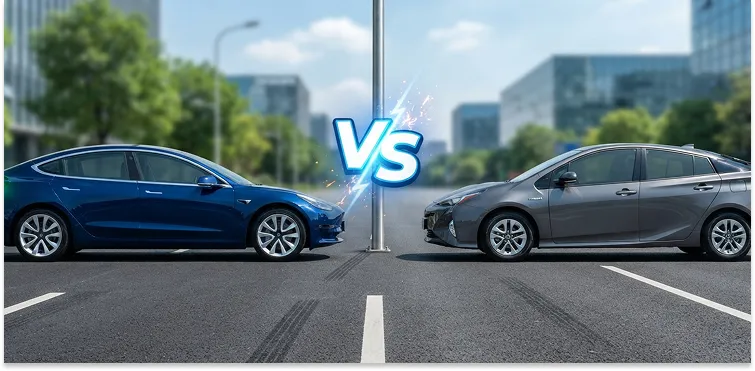
Choosing between an electric car (EV) and a hybrid car is one of the biggest decisions modern car buyers face. Both options offer better fuel economy and lower emissions than traditional gasoline-powered vehicles, but they work in very different ways.
Electric vehicles run entirely on battery power and produce zero tailpipe emissions. Hybrid cars combine a gasoline engine with an electric motor to improve fuel efficiency while eliminating the need for regular charging. Each has its own strengths, costs, and driving experience.
If you’re wondering whether an electric car or a hybrid is the better choice, this guide explains the key differences in simple terms. We’ll compare everything from driving range and performance to maintenance, environmental impact, and ownership costs so you can make an informed decision.
Key Differences Between Electric Cars vs Hybrid Cars
If you’re planning to buy a car, here’s a side-by-side comparison of the most important differences between electric and hybrid cars to help you make the right choice.
| Feature | Electric Cars (EVs) | Hybrid Cars |
| Power Source | Battery and electric motor only | Gasoline engine and electric motor |
| Fuel | Electricity | Gasoline and electricity |
| Tailpipe Emissions | Zero | Lower than gasoline cars but not zero |
| Charging | Requires charging | Usually self-charging through regenerative braking and engine |
| Driving Range | Depends on battery size | Longer combined range with fuel tank |
| Running Costs | Lower | Moderate |
| Maintenance | Fewer moving parts | More components to maintain |
| Acceleration | Instant torque and quick response | Smooth but generally less powerful |
| Purchase Price | Usually higher | Often more affordable |
| Best For | Daily commuting and eco-conscious drivers | Long-distance drivers and those without charging access |
Learn More:
- AWD vs FWD Explained
- Certified Pre-Owned vs Regular Used Car
- New vs Used Car
- Mercedes vs Porsche
- BMW vs Audi for US Military
- AWD vs 4WD
What Is an Electric Car (EV)?
An electric vehicle (EV) is powered entirely by an electric motor and a rechargeable battery. Unlike conventional vehicles, it does not use a gasoline or diesel engine.
The battery stores electricity, which powers the motor to drive the wheels. Drivers recharge the battery using a home charger, workplace charger, or public charging station.
Popular electric cars include the Tesla Model 3, Hyundai Ioniq 5, Kia EV6, BMW i4, Nissan Leaf, and Ford Mustang Mach-E.
Because EVs have no exhaust system, they produce zero tailpipe emissions and are considered one of the cleanest transportation options available today.
What Is a Hybrid Car?
A hybrid car combines two power sources—a gasoline engine and an electric motor. The vehicle automatically switches between the two or uses both together for better efficiency.
Unlike fully electric vehicles, most hybrid cars do not need to be plugged in. Their batteries recharge automatically through regenerative braking and the gasoline engine.
Common hybrid models include the Toyota Prius, Toyota Corolla Hybrid, Honda Accord Hybrid, Hyundai Elantra Hybrid, and Kia Niro Hybrid.
Hybrid vehicles are designed to reduce fuel consumption while offering the convenience of traditional refueling.
1. Power Source
If you’re buying a car for the first time, understanding how electric cars and hybrid cars generate and use power is one of the best places to start.
Electric Cars
Electric cars rely entirely on rechargeable lithium-ion battery packs. Electricity powers the electric motor, eliminating the need for gasoline.
The larger the battery, the farther the vehicle can travel on a single charge.
Hybrid Cars
Hybrid cars use both an internal combustion engine and an electric motor. The vehicle intelligently selects the most efficient power source based on speed, driving conditions, and battery charge.
This combination improves fuel economy while maintaining the flexibility of gasoline.
4. Driving Range
Driving range is an important factor, especially if you regularly commute or take long-distance trips, and it’s worth reviewing alongside your car inspection checklist when comparing vehicles.
Electric Cars
Modern EVs offer impressive driving ranges. Many new electric vehicles can travel between 250 and 400 miles (400–640 km) on a single charge, while premium models may exceed that range.
However, cold weather, high speeds, and heavy use of air conditioning or heating can reduce battery range.
Hybrid Cars
Hybrid cars usually offer a much longer total driving range because they combine battery power with a gasoline tank.
Many hybrids can travel 500 to 700 miles (800–1,100 km) before needing to refuel, making them ideal for frequent road trips.
5. Charging vs Refueling
Another major difference is how each vehicle gets its energy and how long it takes to get back on the road.
Electric Cars
Electric vehicles require charging instead of refueling.
Charging options include:
- Home charging
- Workplace charging
- Public AC chargers
- DC fast chargers
Charging times vary from around 30 minutes with fast chargers to several hours using home charging equipment.
Hybrid Cars
Most hybrid cars don’t require charging.
Drivers simply refill the gasoline tank at any fuel station, while regenerative braking continuously recharges the battery during driving.
This convenience makes hybrids attractive for people without easy access to charging stations.
6. Performance and Acceleration
Performance and acceleration can significantly influence how enjoyable and responsive a vehicle feels on the road, yet overlooking them is one of the common mistakes people make when buying cars.
Electric Cars
Electric motors deliver maximum torque instantly.
This allows EVs to accelerate quickly and smoothly without waiting for engine RPM to build. Even many family EVs feel surprisingly responsive.
Performance-focused electric vehicles can achieve sports-car-level acceleration.
Hybrid Cars
Hybrid vehicles also provide smooth acceleration, especially at lower speeds where the electric motor assists the engine.
However, most hybrids focus on efficiency rather than performance, making acceleration less aggressive than many EVs.
7. Driving Experience
Beyond performance, the overall driving experience can make a big difference in your everyday comfort and enjoyment.
Electric Cars
Electric cars provide a quiet, refined, and vibration-free driving experience.
Without engine noise, the cabin feels peaceful, while instant power delivery makes city driving enjoyable.
Many EVs also feature advanced driver assistance systems and regenerative braking, allowing one-pedal driving in many situations.
Hybrid Cars
Hybrid vehicles feel familiar to anyone who has driven a gasoline-powered car.
The transition between electric power and the gasoline engine is often smooth, although drivers may occasionally notice the engine starting during acceleration.
8. Fuel Efficiency and Energy Efficiency
Efficiency is one of the biggest reasons drivers choose electric or hybrid cars over traditional gasoline vehicles, but it’s also worth understanding dealer tricks to watch out for when comparing fuel economy claims.
Electric Cars
Electric vehicles are extremely energy efficient because electric motors convert a much larger percentage of stored energy into movement.
Since they don’t burn fuel, electricity generally costs less than gasoline for the same driving distance.
Hybrid Cars
Hybrid cars significantly reduce fuel consumption compared to conventional vehicles.
Their electric motor supports the engine during acceleration and low-speed driving, helping achieve excellent fuel economy in city traffic.
9. Running Costs
Running costs are an important consideration because they directly affect the overall cost of owning a vehicle.
Electric Cars
Electric vehicles generally cost less to operate.
Owners benefit from:
- Lower electricity costs
- Fewer maintenance needs
- No engine oil changes
- Reduced brake wear due to regenerative braking
These savings can become substantial over several years.
Hybrid Cars
Hybrid cars also reduce fuel expenses compared to gasoline vehicles.
However, they still require fuel purchases, engine servicing, oil changes, and other maintenance related to the combustion engine.
10. Maintenance Requirements
Maintenance requirements can have a significant impact on both ownership costs and long-term reliability.
Electric Cars
EVs have fewer mechanical components.
There are no:
- Spark plugs
- Timing belts
- Engine oil
- Exhaust systems
- Fuel filters
This typically results in lower maintenance costs throughout ownership.
Hybrid Cars
Hybrid cars contain both electric and gasoline systems.
While hybrids are generally reliable, they still require routine maintenance such as:
- Oil changes
- Air filter replacement
- Engine servicing
- Cooling system maintenance
Their more complex drivetrain can increase long-term maintenance requirements.
11. Battery Life and Replacement Costs
Battery life and replacement costs are important factors to consider when evaluating long-term ownership, along with the signs of a bad car you should never ignore before buying.
Electric Cars
Modern EV batteries are designed to last many years.
Most manufacturers provide battery warranties of around 8 years or 100,000 miles, and many batteries continue performing well beyond that period.
Battery replacement can be expensive, although prices continue to decrease as technology improves.
Hybrid Cars
Hybrid batteries are smaller and generally less expensive to replace than EV batteries.
They also last many years, with many owners driving well over 100,000 miles before experiencing battery-related issues.
12. Environmental Impact
Both vehicle types help reduce emissions, but their overall environmental impact is not the same.
Electric Cars
Electric cars produce zero tailpipe emissions.
When charged using renewable energy such as solar or wind power, they offer one of the lowest environmental impacts among passenger vehicles.
Battery production does require significant resources, but lifetime emissions are generally much lower than gasoline-powered vehicles.
Hybrid Cars
Hybrid cars emit less carbon dioxide than conventional vehicles because they consume less fuel.
However, they still burn gasoline and produce exhaust emissions during normal driving.
They offer a practical balance between improved efficiency and everyday convenience.
14. Purchase Price
If you’re buying a car on a tight budget, comparing the upfront purchase price of each option is just as important as considering long-term savings.
Electric Cars
Electric vehicles often have higher upfront prices due to their large battery packs.
However, government incentives, tax credits, and lower operating costs may reduce the overall cost of ownership.
As battery technology advances, EV prices continue to become more competitive.
Hybrid Cars
Hybrid cars are generally less expensive than comparable electric vehicles.
Their lower purchase price makes them appealing to buyers looking for improved fuel economy without a significant initial investment.
15. Insurance Costs
Before making a purchase, it’s worth comparing how insurance premiums differ between electric and hybrid cars.
Electric Cars
Insurance premiums for electric vehicles can sometimes be higher because battery systems and specialized parts are expensive to repair or replace.
However, rates vary depending on the model, driver history, and insurance provider.
Hybrid Cars
Hybrid vehicles often have insurance costs similar to conventional gasoline cars.
Premiums are generally more affordable than luxury or high-performance electric vehicles, although repair costs may still influence pricing.
16. Reliability and Lifespan
Understanding the expected lifespan of each vehicle can help you make a smarter long-term investment.
Electric Cars
Electric vehicles have fewer moving parts, reducing the number of components that can wear out.
Many EV owners experience excellent long-term reliability with minimal mechanical issues.
Software updates can also improve vehicle performance and add new features over time.
Hybrid Cars
Hybrid vehicles have built a strong reputation for reliability, especially models from manufacturers like Toyota and Honda.
With proper maintenance, many hybrids remain dependable for hundreds of thousands of miles.
Pros and Cons of Electric Cars
Before choosing an electric car, it’s important to weigh its key benefits against its potential drawbacks.
Advantages
- Zero tailpipe emissions
- Lower running costs
- Quiet and smooth driving
- Instant acceleration
- Fewer maintenance requirements
- Home charging convenience
- Reduced dependence on gasoline
- Excellent energy efficiency
Disadvantages
- Higher purchase price
- Charging takes longer than refueling
- Charging infrastructure varies by location
- Battery replacement can be costly
- Driving range may decrease in extreme temperatures
Pros and Cons of Hybrid Cars
Before choosing a hybrid car, it’s helpful to understand both its advantages and potential limitations.
Advantages
- Excellent fuel economy
- Long driving range
- Quick gasoline refueling
- No need for regular charging
- Lower purchase price than many EVs
- Familiar driving experience
- Well-suited for long-distance travel
Disadvantages
- Still produces emissions
- Requires engine maintenance
- More mechanical complexity
- Fuel costs remain ongoing
- Less environmentally friendly than fully electric vehicles
Which Is Better for Different Driving Needs?
The best choice depends on your driving habits, budget, and access to charging.
Choose an electric car if you:
- Drive mostly around town
- Have access to home charging
- Want lower long-term operating costs
- Prefer zero tailpipe emissions
- Enjoy modern technology and instant acceleration
Choose a hybrid car if you:
- Frequently travel long distances
- Don’t have reliable charging access
- Want better fuel economy without changing your driving routine
- Prefer fast refueling
- Need maximum flexibility for all types of journeys
Both technologies offer significant advantages over traditional gasoline vehicles. Your daily driving patterns are often the biggest factor in deciding which option is right for you.
Final Verdict
When comparing electric cars vs hybrid cars, neither option is universally better—they simply serve different needs.
Electric cars are the ideal choice for drivers who want lower running costs, zero tailpipe emissions, quieter driving, and access to the latest automotive technology. They are especially practical for daily commuting and households with convenient charging options.
Hybrid cars remain an excellent alternative for drivers who regularly take long trips, lack access to charging infrastructure, or want improved fuel efficiency without changing their refueling habits. They combine the convenience of gasoline with the efficiency benefits of electric power, making them a practical transition toward cleaner transportation.
Ultimately, the better choice depends on your budget, driving distance, charging availability, and long-term ownership goals. By considering these factors carefully, you can select the vehicle that best fits your lifestyle while enjoying improved efficiency, lower fuel consumption, and a more sustainable driving experience.