
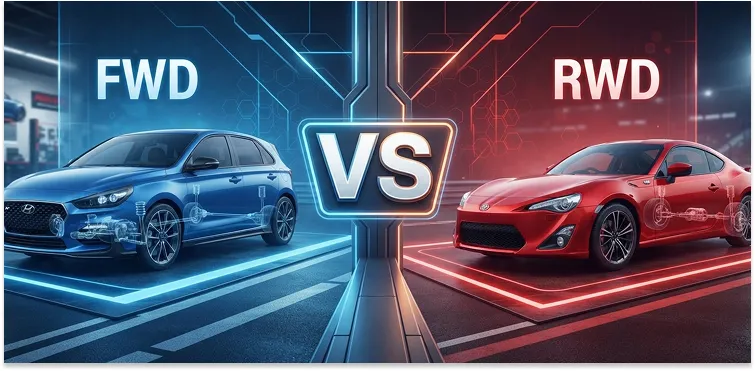
When buying a used car, the drivetrain is one of the most important factors to consider. Two of the most common systems are front-wheel drive (FWD) and rear-wheel drive (RWD).
While both can provide reliable and enjoyable driving, they behave differently on the road and offer different advantages for used-car buyers.
FWD vehicles send engine power to the front wheels, while RWD vehicles send power to the rear wheels. This difference affects traction, handling, acceleration, fuel economy, maintenance, and even the amount of interior space available.
So, which is better when buying a used car: FWD or RWD? The answer depends on how you drive, where you live, your budget, and the type of performance you expect from your vehicle.
Key Differences Between FWD vs RWD
To make the choice easier, here’s a quick comparison of the key differences between FWD and RWD when buying a used car.
| Feature | FWD | RWD |
| Power distribution | Engine power goes to the front wheels | Engine power goes to the rear wheels |
| Traction | Generally better on slippery roads | Can lose traction more easily in poor conditions |
| Handling | Stable and predictable | More balanced and engaging |
| Performance | Practical for everyday driving | Better suited to sporty driving and acceleration |
| Fuel economy | Often more efficient | Can use slightly more fuel in some vehicles |
| Towing | Usually limited compared with RWD | Generally better for towing and heavy loads |
| Maintenance | Often simpler and less expensive | May have additional drivetrain components |
| Interior space | Often offers more cabin space | May have a transmission tunnel |
| Best for | City driving, commuting, and practical use | Performance, towing, and enthusiast driving |
Learn More:
- AWD vs FWD Explained
- Certified Pre-Owned vs Regular Used Car
- New vs Used Car
- Mercedes vs Porsche
- BMW vs Audi for US Military
- AWD vs 4WD
- Electric Cars vs Hybrid Cars
- Hybrid or Plug-In Hybrid
Power Distribution
The biggest difference between FWD and RWD is where the engine sends its power, so when buying a used car. It is also important to check mileage when buying a used car and test-drive a car properly before buying to better understand the vehicle’s overall condition.
FWD
In a front-wheel-drive vehicle, the front wheels both steer the car and receive power from the engine. This setup is compact and efficient, which is why it is common in hatchbacks, compact cars, sedans, and many modern SUVs.
RWD
In a rear-wheel-drive vehicle, the engine sends power to the rear wheels. The front wheels are mainly responsible for steering, while the rear wheels push the vehicle forward. This layout is common in sports cars, luxury vehicles, pickup trucks, and performance-focused SUVs.
Traction and Road Grip
The drivetrain also affects how well a used car maintains traction and stays connected to the road in different driving conditions.
FWD
FWD cars generally provide good traction during normal driving because the engine’s weight is positioned over the front wheels. This can help the vehicle maintain grip when starting from a stop, particularly on wet or lightly slippery roads.
RWD
RWD vehicles can provide excellent traction in dry conditions, but the rear wheels may spin more easily on wet, icy, or snowy roads. Modern traction control systems help reduce this problem, but tire quality and driving habits remain important.
Acceleration and Performance
If performance matters to you, the drivetrain plays an important role in how a used car accelerates and delivers power.
FWD
FWD is perfectly capable of delivering strong acceleration for everyday driving. However, powerful FWD cars can sometimes experience torque steer, where the steering wheel pulls slightly under hard acceleration.
RWD
RWD is often preferred for performance driving. During hard acceleration, the vehicle’s weight shifts toward the rear, helping the powered rear wheels gain additional grip. This makes RWD popular in performance cars from brands such as BMW, Mercedes-Benz, and Ford.
Handling and Cornering
The difference between FWD and RWD also becomes clear when taking corners and handling the car on winding roads.
FWD
FWD cars are usually easy to control and predictable through corners. However, when pushed aggressively, they can experience understeer, meaning the car tends to continue straight instead of turning as sharply as intended.
RWD
RWD vehicles often offer a more balanced driving experience. Since the front wheels focus on steering and the rear wheels provide power, many RWD cars feel more responsive and engaging when cornering.
Driving in Rain and Snow
Weather and road conditions are important factors to consider, especially if you regularly drive in rain, snow, or on slippery surfaces.
FWD
For many used-car buyers, FWD is the safer, practical choice for rainy or snowy conditions. The weight over the front wheels can help provide better traction when moving away from a stop.
RWD
RWD can be more challenging in slippery weather, especially when fitted with worn or low-quality tires. However, a RWD vehicle with good winter tires, modern stability control, and careful driving can still perform well in difficult conditions.
Fuel Economy
For many used-car buyers, fuel economy is a major ownership cost, and the drivetrain can influence overall efficiency.
FWD
FWD vehicles are often lighter and use a more compact drivetrain. This can help them deliver better fuel economy, especially in small cars and family sedans.
RWD
RWD vehicles can sometimes be heavier because of the additional drivetrain components needed to transfer power to the rear wheels. However, fuel economy depends heavily on the engine, transmission, vehicle weight, and driving style.
Towing and Hauling Capability
If you plan to tow a trailer or carry heavy loads, the drivetrain can make a significant difference in how capable the vehicle is.
FWD
FWD vehicles can handle light towing, depending on the manufacturer’s specifications. However, they are generally not the first choice for frequent towing or carrying heavy loads.
RWD
RWD is usually better for towing and hauling. Pickup trucks and larger SUVs commonly use RWD or four-wheel-drive systems because the rear wheels can provide strong traction when carrying heavy loads or pulling a trailer.
Maintenance and Repair Costs
Before choosing between FWD and RWD, it is also important to consider how each drivetrain may affect future maintenance and repair expenses.
FWD
FWD systems are often compact and efficient, but repairs can sometimes be expensive because many components are located together at the front of the vehicle. CV axles and front drivetrain components may also experience significant wear.
RWD
RWD vehicles have additional components such as a driveshaft and rear differential. These parts can require maintenance over time. However, many RWD systems are durable and designed to handle higher power and heavier workloads.
Used Car Reliability
Reliability matters even more when buying used, so the drivetrain and the vehicle’s maintenance history both deserve careful attention.
FWD
A well-maintained FWD car can be highly reliable for many years. When inspecting a used FWD vehicle, pay attention to CV joint noises, transmission performance, suspension wear, and uneven tire wear.
RWD
A used RWD car can also be extremely reliable, particularly when its drivetrain has been properly serviced. Buyers should check the condition of the driveshaft, differential, transmission, and suspension components.
The vehicle’s maintenance history is usually more important than the drivetrain alone. A properly maintained RWD car may be a better purchase than a neglected FWD vehicle.
Tire Wear and Replacement Costs
Tire wear can also vary between FWD and RWD vehicles, which may affect your regular maintenance and replacement costs.
FWD
FWD cars can experience more wear on the front tires because the front wheels handle steering, braking forces, and engine power. Regular tire rotation and proper wheel alignment can help extend tire life.
RWD
RWD cars may distribute driving forces differently across the vehicle. However, aggressive acceleration can cause faster wear on the rear tires. Performance RWD cars may also use wider and more expensive tires.
Interior Space and Practicality
Beyond driving performance, the drivetrain can also influence how much interior space and everyday practicality a used car offers.
FWD
One major advantage of FWD is packaging efficiency. Because the drivetrain is concentrated at the front, many FWD vehicles offer a flatter cabin floor and more usable interior space.
RWD
Many RWD vehicles have a transmission tunnel running through the center of the cabin. This can reduce rear-seat foot space, although larger sedans and SUVs often provide plenty of room.
Purchase Price and Long-Term Ownership Costs
Finally, look beyond the sticker price by considering your ways to finance a car and the overall cost of ownership.
Fuel, maintenance, repairs, and knowing how to avoid overpaying at a car dealership can all affect what you actually spend over time.
FWD
FWD used cars are often available at a wide range of prices. They are particularly common in the affordable used-car market, making them attractive to commuters and budget-conscious buyers.
Their combination of fuel efficiency, practical design, and broad availability can also help keep long-term ownership costs manageable.
RWD
RWD used cars may cost more to purchase, especially when buying a luxury car, sports car, or pickup truck. Insurance, tires, fuel, and maintenance can also be more expensive depending on the vehicle.
However, the additional cost may be worthwhile for buyers who need towing capability or want a more engaging driving experience.
Best Choice for City and Daily Driving
For most city drivers, commuters, and families, FWD is usually the better choice. It offers predictable handling, good fuel economy, strong practicality, and generally good traction for everyday road conditions.
A used FWD hatchback, sedan, or compact SUV can be an excellent choice for someone who mainly drives to work, shops, attends school, or travels on paved roads.
Best Choice for Performance and Enthusiastic Driving
For drivers who enjoy acceleration, cornering, and a more engaging driving experience, RWD is often the preferred option.
RWD allows manufacturers to create balanced performance vehicles and is commonly found in sports cars, muscle cars, luxury sedans, and performance SUVs. It can also provide a more rewarding experience for experienced drivers.
Which Is Better for Different Used-Car Buyers?
The best choice between FWD and RWD depends on your driving habits, budget, road conditions, and what you expect from your next used car.
Choose FWD if you:
- Mainly drive in cities and urban areas
- Want better everyday practicality
- Prefer potentially lower fuel costs
- Regularly drive in wet or mildly slippery conditions
- Want a larger selection of affordable used cars
- Need a comfortable commuter or family vehicle
Choose RWD if you:
- Want a sportier driving experience
- Regularly tow trailers or carry heavy loads
- Prefer powerful acceleration
- Want a sports car or performance sedan
- Need a pickup truck for work
- Enjoy more responsive handling
Pros and Cons of Buying a Used FWD Car
FWD vehicles are popular because they combine practicality, efficiency, and easy everyday driving, but understanding their advantages and drawbacks can help you avoid common mistakes people make, especially when buying a car for the first time.
| Pros | Cons |
| Good traction for everyday driving | Can experience torque steer in powerful models |
| Often better fuel economy | Front tires may wear faster |
| Usually offers good interior space | Less suitable for heavy towing |
| Common in the affordable used-car market | Can understeer during aggressive cornering |
| Practical for city and family driving | Some front drivetrain repairs can be expensive |
Pros and Cons of Buying a Used RWD Car
RWD vehicles are attractive to drivers who want stronger performance, towing ability, or a more traditional driving experience. However, ownership costs and slippery-weather performance should be considered.
| Pros | Cons |
| Excellent performance potential | May have higher fuel costs |
| Balanced and engaging handling | Can lose traction on slippery roads |
| Better for towing and heavy loads | Some models have higher maintenance costs |
| Strong acceleration capability | Often less interior space |
| Popular in performance and luxury cars | Used performance models may have been driven aggressively |
Which Used Car Should You Buy?
The best choice between FWD and RWD depends on your actual driving needs. If you want a reliable, practical, and economical used vehicle for commuting and everyday transportation, FWD is likely the better option, especially when buying a car on a tight budget.
If you want a more engaging driving experience, need better towing capability, or are shopping for a sports car, luxury vehicle, or pickup truck, RWD may be the better fit.
When buying any used car, do not focus only on the drivetrain. Check the vehicle’s service records, accident history, mileage, tire condition, suspension, transmission, and overall mechanical condition, while also looking out for the signs of a bad used car you should avoid. A professional pre-purchase inspection can also help identify expensive problems before you buy.
Final Verdict
For most used-car buyers, FWD is the better all-around choice because it offers practicality, good fuel economy, reliable everyday traction, and a wide selection of affordable vehicles.
However, RWD is the better choice for performance enthusiasts, towing needs, and drivers who value balanced handling and stronger acceleration.
In the end, neither drivetrain is universally better. The right choice is the one that matches your lifestyle, driving conditions, budget, and expectations from your next used car.